Horse Browser is a new web browser, designed for online research. As you browse, every link opens in a new page and is saved on a Trail, a list of nested pages stored in your sidebar. This allows you to keep track of research and say goodbye to the messy tabs you’re used to.
In this post, we’ll learn where you can find the address bar in Horse Browser and also how you can view, edit and copy URLs.
Where is the address bar in Horse Browser?
Horse Browser is designed to be a distraction-free browser, that helps you focus on research. Just as you won’t find zip codes cluttering up Google Maps or full addresses listed on apartment buildings, we believe users don’t need to be distracted by the visual clutter of URLs at the top of their browser. It’s simply not necessary to see the address at all times. Consequently, we have removed the address bar in Horse Browser so that our users can enjoy the most calming and minimalist browsing experience possible.
How can I view and edit the URL of a webpage?
That said, we know users might want to access a page’s URL to view, edit or copy a link. So we’ve made that super simple to do too.
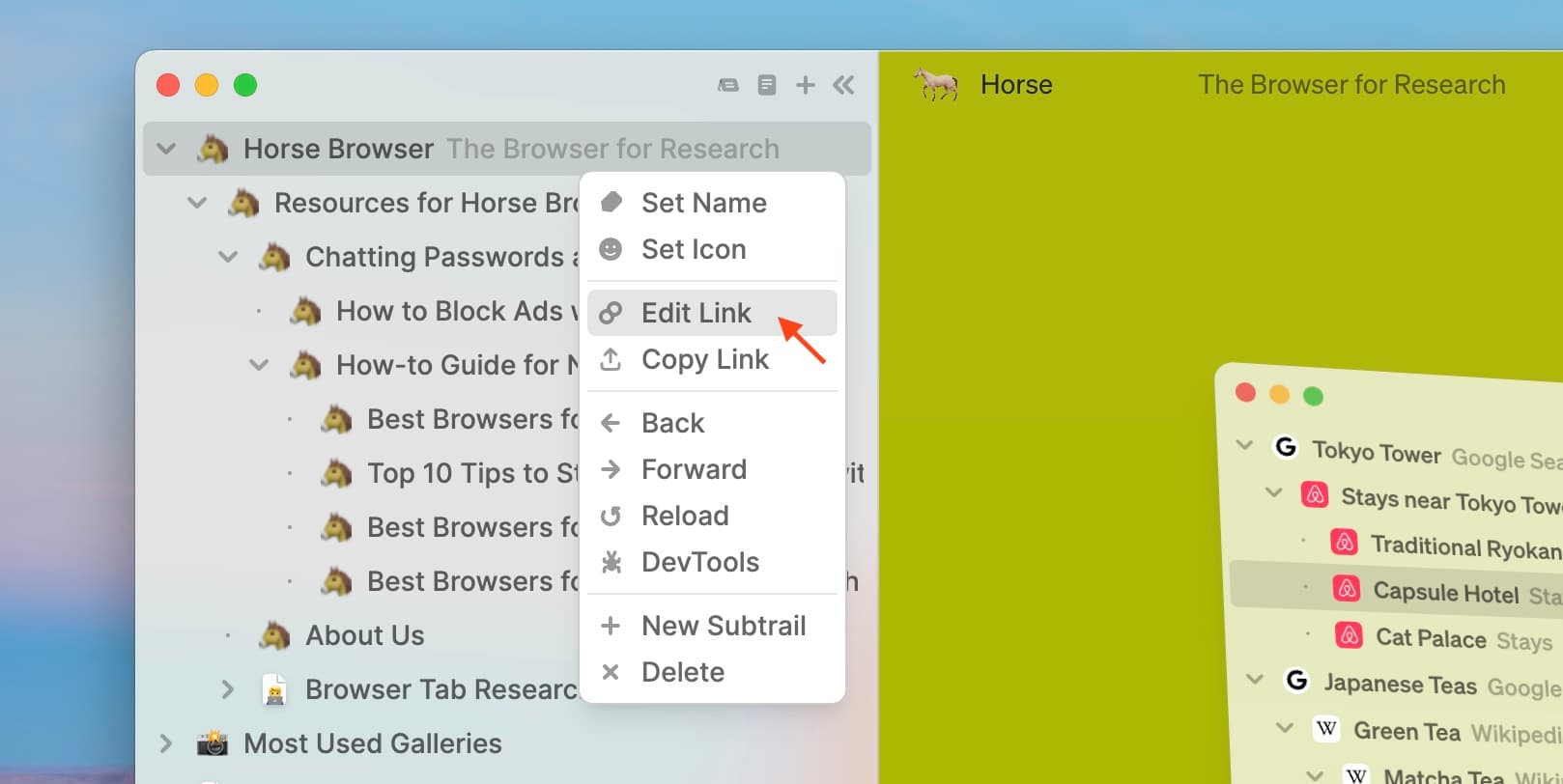
You can double-click on a page anytime to view and edit the URL. Or you can click ••• at the side of each page and choose edit link.

How can I copy the URL of a webpage?
You can select a URL by clicking a second time on the link. When a link is selected, enter ⌘ + C on Mac or Ctrl + C on Windows / Linux to copy the URL. You can also copy the URL, by choosing the copy link option, underneath edit link in the ••• menu.
Alternatively, you can use a keyboard shortcut to copy the URL of the current page. Enter ⌘ + ⇧ + C on Mac or Cmd + Shift + C on Windows / Linux.
In conclusion
Horse Browser eliminates the clutter of the address bar that appears in standard browsers. By removing the address bar, Horse Browser frees up valuable screen real estate for the webpage itself. The result is a clean, minimalist design, aimed to help you focus online. That said, Horse Browser also allows you to easily view, edit and copy URLs, whenever you need to.
To learn more about Horse Browser, visit here. Or read more how-to guides in our Manual blog series.