Pascal wrote about habits and friendships, linking one page to another until a structure appeared. The part that caught him was almost comically small: turn a passage into a page, and those words become a link while the new page appears beneath its parent in the sidebar. Notion did not ask him to file the page or explain where it belonged. Creating it established the relationship.
Pascal met Eleanor in Lisbon in 2021. Horse did not exist. A year later, Martijn Verbove, whose company WebScape was building a command palette for Chrome, told Pascal that tabs were broken. Pascal asked why he was building around tabs rather than fixing them. Martijn laughed and said, “Who do you think you are? Google?”
The question was funny because it was fair. Tabs were not a loose component waiting for a clever redesign. They were what appeared when the browser discarded the relationship between one page and the next. Fixing them properly meant rethinking navigation itself, then spending years building the answer. This was exactly the sort of unreasonable project Pascal wanted.
He went backwards. Before deciding what a browser should become, Pascal wanted to see which old decision had made tabs feel inevitable.
The first browser, WorldWideWeb, treated the web like a collection of connected documents. You could open several pages at once and move them around like documents on a desktop. It felt less like operating a browser and more like working directly with the web. Have a poke around. The windows below still move.
Then the Line Mode Browser made the web work in a terminal. A terminal could show one document at a time, so the browser needed an address, a current page, and commands to go backwards or forwards. Those controls were practical answers to the limits of the machine.
Mosaic carried that model into a graphical window: toolbar at the top, address beneath it, one current page filling the rest. The machine no longer had the terminal’s limits, but the navigation remained. Later browsers added tabs to keep several current pages within reach. Tabs relieved the pressure without restoring the relationships between those pages.
World Wide Web
The WorldWideWeb (W3) is a wide-area hypermedia information retrieval initiative aiming to give universal access to a large universe of documents.
Everything there is online about W3 is linked directly or indirectly to this document, including an executive summary of the project, Mailing lists, Policy, November’s W3 news, and more.
That was the deeper problem. URLs are excellent addresses, but an address does not explain why you went somewhere. Back and Forward can retrace a line, but real work rarely behaves like one. Tabs preserve the pages while throwing away the journey that made them useful.
Back home, the Notion idea clicked into place. A URL could remain the address of a page without deciding how the browser showed it. The browser already knew which link a person had opened and which page they had opened it from. It could keep that relationship visible instead of flattening every page into a tab.
That became Trails®. Open a link and the new page appears directly beneath the page that led you there. Keep browsing and Trails® grow vertically, preserving the order of the work without asking you to organize it twice. Collapse what you do not need now. Everything remains where it belongs.
The first prototypes proved the idea and very little else. Google Docs was broken. Clicks could be slow. Horse had no extensions or password manager, and plenty else remained magnificently unfinished.
People told Pascal to make it work like Chrome. He nearly stopped. Chrome was already splendid at being Chrome, and building a worse copy of it would have been a truly heroic waste of everyone’s time.
Eleanor saw the part worth protecting. She used the awkward prototypes as her real browser and kept insisting that the strange navigation mattered more than familiarity. She caught what failed along the way. Her judgment gave the idea time to become a product. When other people began using Horse too, she helped turn a stubborn experiment into a company.
At first, Eleanor and Pascal called Horse “the browser for research.” It was the clearest way to describe a browser that kept the route through a subject visible. Eleanor is a Wadham College, Oxford alumna, and the College mentioned Horse on its website. That early vote of confidence helped a strange new browser from Lisbon receive some welcome attention, and Eleanor and Pascal remain enormously grateful for it.
Those first Riders accepted missing conveniences because Trails® gave back something they could not get elsewhere: visible context. The rough edges were not a philosophy. They were work left to do, so Eleanor and Pascal did the work.
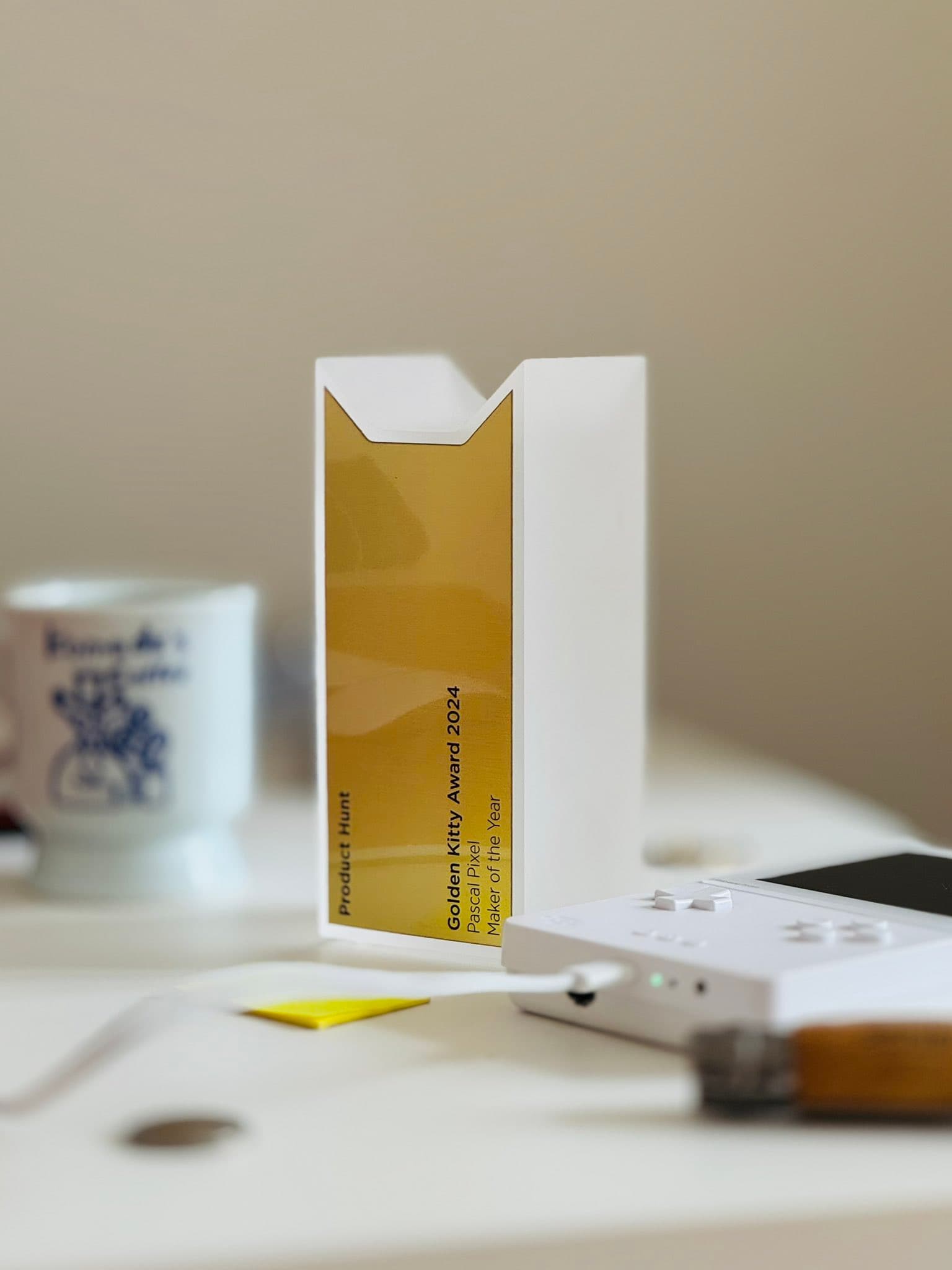
In 2024, Horse reached Product Hunt’s Golden Kitty Awards. It took second place in Bootstrapped & Small Teams, and Product Hunt named Pascal Maker of the Year. The award arrived as a golden cat, which felt exactly right for an independent browser from a two-person company with a questionable regard for sensible workloads. Eleanor and Pascal wrote down what the moment meant while it was still happening.
The recognition was wonderful. It did not make extensions magically appear.
Riders already had their digital lives in password managers such as 1Password and Bitwarden. Horse was built on Electron, which could not yet run the extension architecture those tools depended on. Sam Maddock had written the upstream work needed to change that, but a change this large needed the Electron team to see how much it mattered.
Eleanor and Pascal made Help Extend Horse, a campaign with one request: visit Sam's pull request and add your support. No donation or code contribution, just make the need impossible to miss.
Within three days, it became the most-upvoted pull request in Electron's history. The Electron team merged the foundation, making this new class of extensions possible across the Electron ecosystem.
Possible was the beginning, not the finish. Extension support reached deep into assumptions Horse had made before extensions were part of its world. From 2025, Pascal spent more than a year rebuilding those foundations without sacrificing Trails®. The codebase more than doubled before the first extension could ship properly.
In July 2026, Horse 3.3 ran its first tested extensions. Stable Horse now supports seven, including the password managers Riders had asked for at the start. The journal follows the route from Sam's work to the extensions running in Horse.
ADHD entered the story later. Pascal was diagnosed in 1996, but he did not begin Horse from an ADHD theory. Over time, many of the Riders who stayed told Eleanor and Pascal they had ADHD and that keeping the route through a task on screen made it easier to return. That pattern helped them understand who needed Horse most. The ADHD page explains why visible context can help.
Today, Google Docs works. Horse includes a password manager and supports tested extensions. Opening a link no longer asks for a small act of faith. The ordinary browser work is ordinary now. Trails® remain gloriously different.
Eleanor and Pascal now build Horse full time from Lisbon. Eleanor runs marketing and operations. Pascal designs and engineers the browser. Riders pay for Horse, which gives their two-person company a wonderfully short chain of command: make the browser excellent for Riders.
Horse does not track what you browse. A browser should be able to know a great deal about your day without its maker knowing any of it.
Changing browser navigation took years because the problem was genuinely large. Eleanor and Pascal did not shrink the idea until it looked reasonable. They kept building until Horse became a proper browser with a radically better memory for work.
Broken was never the same as impossible. It was simply a magnificent amount of work.